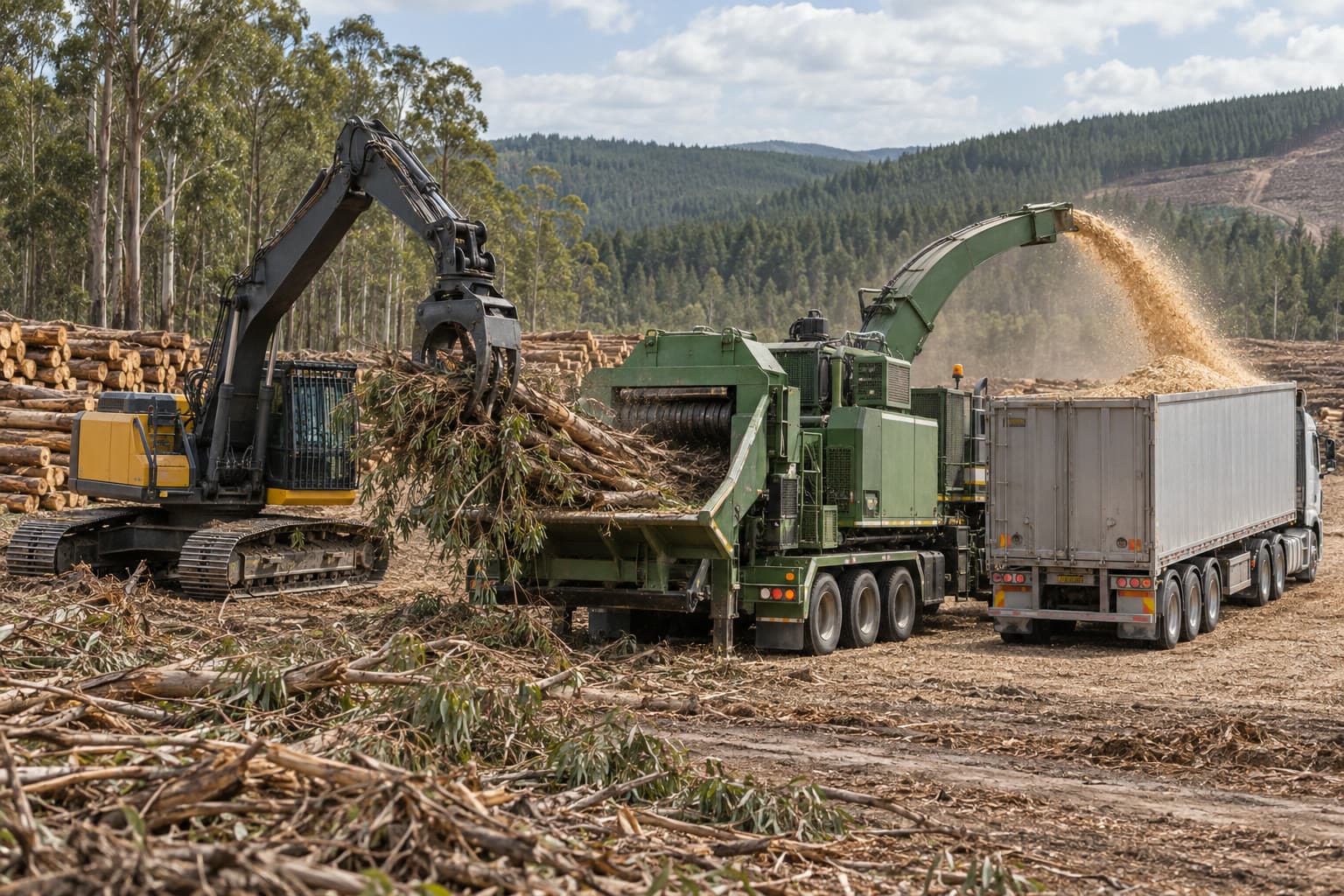
Biomass systems begin with an offtake specification. Particle size, contamination tolerance, moisture, delivery schedule and rejection rules determine whether clean chipping, grinding or another processing route can produce an accepted material.
The processor should be sized with the loader, feedstock presentation, trailer changeover and transport cycle. Peak tonnes per hour from the chipper or grinder are irrelevant when feeding is intermittent or finished product has nowhere to go.
Plan the operation in sequence
Capacity added to one stage only helps when the next stage can accept it. Resolve the complete material path before comparing models.
Where this system makes sense
Machine classes to investigate
These are starting points. Carrier capacity, support coverage and the production constraint decide the final combination.
Whole-tree chippers
Read benchmark specifications, buyer criteria, ownership costs and the traps that change this class in Australian conditions.
Horizontal grinders
Read benchmark specifications, buyer criteria, ownership costs and the traps that change this class in Australian conditions.
Forestry grapples
Read benchmark specifications, buyer criteria, ownership costs and the traps that change this class in Australian conditions.
Questions to answer in the field
If these inputs are unknown, the supplier is being asked to size equipment around assumptions.
Measures that should decide the purchase
Measure the unit the contract pays for and the delays that prevent the system producing it.