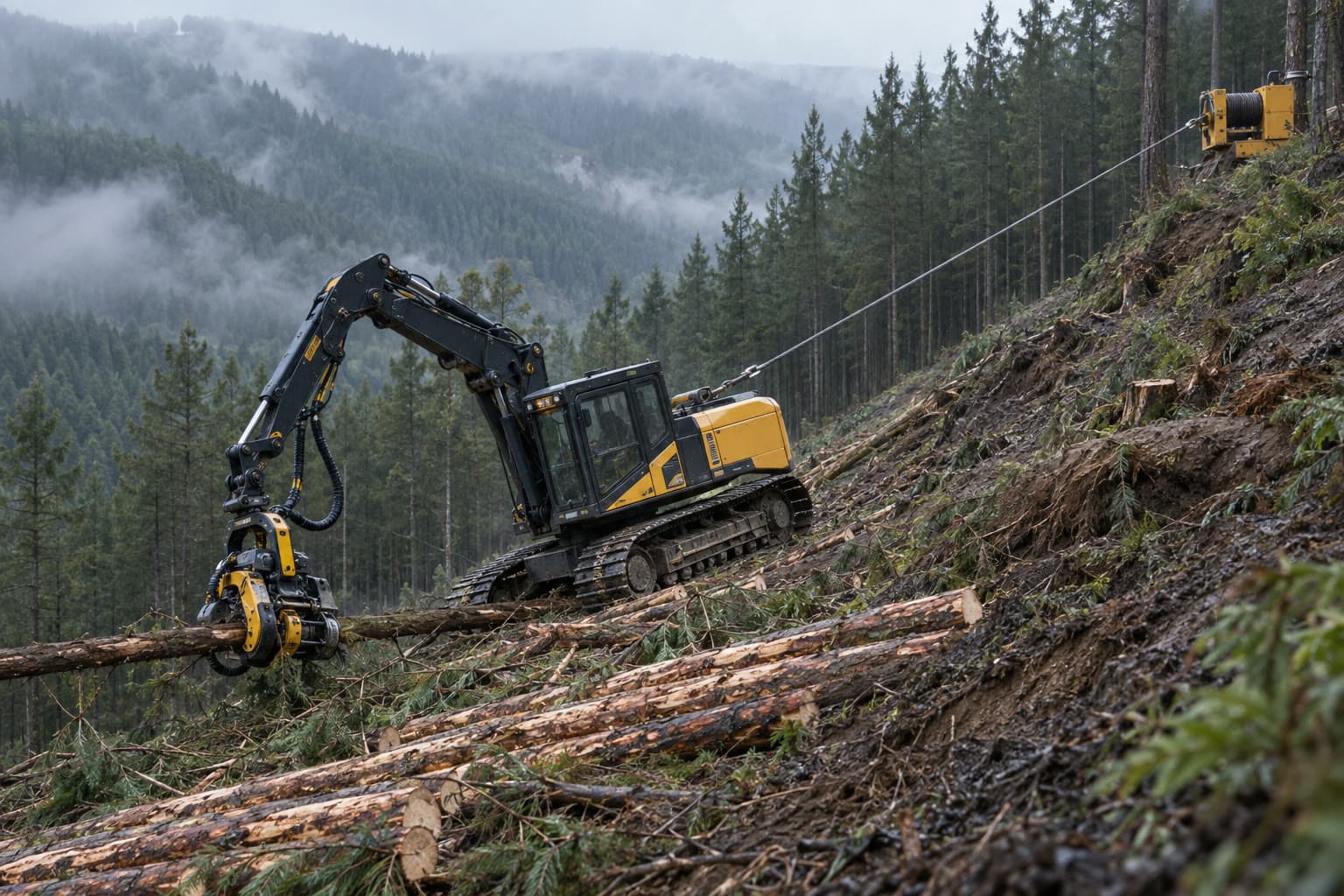
Steep-country harvesting combines production equipment with an engineered access and stability system. Carrier tractive effort, tether capacity, anchor selection, soil condition, slope geometry, extraction method and rescue planning must be assessed together.
A machine being physically capable of travelling on a slope does not establish a safe or profitable operating envelope. The commercial question is how many productive hours the complete system can sustain after moves, anchor changes, weather restrictions, access preparation and extraction delays are included.
Plan the operation in sequence
Capacity added to one stage only helps when the next stage can accept it. Resolve the complete material path before comparing models.
Where this system makes sense
Machine classes to investigate
These are starting points. Carrier capacity, support coverage and the production constraint decide the final combination.
Winch-assist systems
Read benchmark specifications, buyer criteria, ownership costs and the traps that change this class in Australian conditions.
Forestry carriers
Read benchmark specifications, buyer criteria, ownership costs and the traps that change this class in Australian conditions.
Harvester heads
Read benchmark specifications, buyer criteria, ownership costs and the traps that change this class in Australian conditions.
Questions to answer in the field
If these inputs are unknown, the supplier is being asked to size equipment around assumptions.
Measures that should decide the purchase
Measure the unit the contract pays for and the delays that prevent the system producing it.